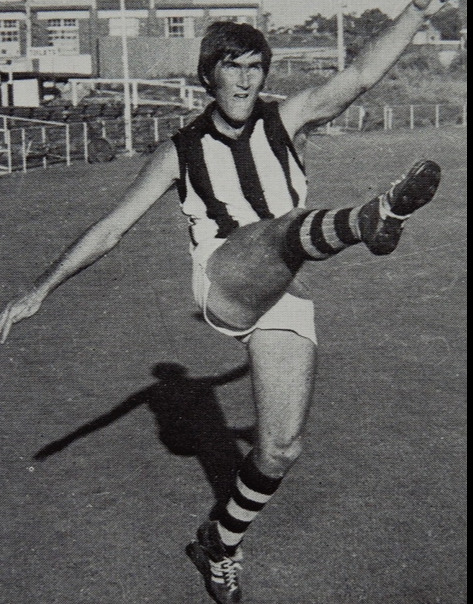


Footballing pedigrees don’t come much better than that with which John Parkinson arrived at Victoria Park in 1971.
This was a man who had jointly won the Sandover Medal for best player in the WAFL, had also won Claremont’s best-and-fairest and had topped that club’s goalkicking three times. He was also a Premiership player and WA interstate representative. Even if he’d made the journey east a little later than most, he still looked like as sure a bet as you could have.
Instead, his single year at Collingwood turned into such a disaster that he’d all but retired from the game half-way through the season.
John Parkinson, universally known as ‘Buzz’, was a bona fide star in Western Australia. He was born in Nedlands, and went to Dalkeith State School and then Scotch College. He started with the Claremont thirds in 1962, and by 1963 had made his senior debut, playing an important role in their 1964 Premiership win over East Fremantle.
Over the next few years he established a reputation as one of the finest rover/forwards in the State. Although lightly built he lacked nothing for courage and was a brilliant ball player. But he was perhaps best renowned for his goalkicking, with the ability to snap and create goals from almost any angle. He won Claremont’s goalkicking on three separate occasions, a huge effort from a small forward who also spent plenty of time in midfield.
His best year was 1967, when he not only won Claremont’s best-and-fairest and goalkicking awards but also tied with the legendary Bill Walker for the Sandover Medal.
Given the form he was in, it was somewhat surprising that he didn’t try his luck in the VFL until 1971. Even so he was only 26 then and should have been in the prime of his career.
But his time at Collingwood would prove disastrous.
It all began to unravel even before he started training with the Pies. First there was a huge fight for his services, with almost all VFL teams expressing their interest. Stories appeared saying he had signed with Geelong, but less than a week later it appeared he had signed with Essendon, who were planning a swap deal with their own rover Bob Greenwood. Claremont were keen on that swap, and threatened to withhold his clearance if he tried to sign with anyone other than the Bombers. So the Magpies moved in to offer a swap of their own, making Colin Tully available. Even so it took until late February until the swap deal was agreed. It was a messy start.
Unfortunately, Parkinson started slowly. His form in the internal practice matches was scratchy, and he didn’t get a game in the main practice match against South Fremantle, or in the opening round of the season. In the end it took until Round 5 for him to make his senior debut, on a half-forward flank against North Melbourne.
He didn’t set the world on fire in his first two games, and in the third dislocated his shoulder in the first quarter. He missed four weeks, then suffered groin and ankle issues but still played three games with the reserves. But he was obviously struggling, and displayed little of the brilliance he had been famous for in the west.
Midway through July came the bombshell: gun recruit John Parkinson was taking a break from the game. He stopped training and stayed away from the Club. In an interview with The Age newspaper, he admitted his early form hadn’t been great, but seemed disappointed he had been consigned to the reserves after recovering from his shoulder.
“Everyone,” he said, “was a bit at fault for this. I believe a player has to be given a frame of mind to believe he is a strong footballer. I did not have the confidence that I could be a footballer at Collingwood.
“At this stage perhaps I didn’t deserve a game. But with Collingwood having many injuries, the club had many opportunities for me to prove myself.”
He stressed that he wasn’t unhappy with the Club but felt he did not have the enthusiasm to excel with the reserves. “I don’t think I would be of any benefit to Collingwood this year.”
So ‘Buzz’ basically sat out the rest of the 1971 season. It was a bizarre end to an ill-fated adventure. He returned to Claremont in 1972 and played two more seasons there before retiring from the game, finishing with a total of 156 WAFL games.
Obviously, Victoria – and Collingwood – never got to see the best of John Parkinson. He was a highly talented footballer who seemingly had all the tools to have been a success here. But sometimes the fates just conspire against you, and for ‘Buzz’ it was an unfortunate combination of circumstances that killed his VFL dream before it had barely got off the ground. But that shouldn’t detract from his brilliant WAFL career, which really was one to savour. If only we could have seen some of that at Victoria Park.
- Michael Roberts
CFC Career Stats
| Season played | Games | Goals | Finals | Win % |
|---|---|---|---|---|
| 1971 | 3 | 1 | 0 | 100.0% |
CFC Season by Season Stats
| Season | GP | GL | B | K | H | T | D | Guernsey No. | ||
|---|---|---|---|---|---|---|---|---|---|---|
Other CFC Games
| Team | League | Years Played | Games | Goals |
|---|---|---|---|---|
| Collingwood | Reserves | 1971 | 7 | 12 |